Electrolysis vs. Laser Hair Removal: Which Is Better?
Electrolysis and laser hair removal both offer longer-lasting results than shaving or waxing, but they remove unwanted hair in different ways. Electrolysis uses electrical energy to treat individual hair follicles for permanent hair removal, while laser hair removal uses concentrated light to reduce hair growth across larger areas.
The biggest difference is the outcome each method is designed to achieve. Electrolysis can permanently stop hair growth from successfully treated follicles, regardless of hair colour or skin tone. Laser hair removal provides long-term hair reduction and is generally faster for larger areas, particularly when the hair contains enough pigment to absorb the laser's energy.
Neither treatment is automatically better for everyone. The right choice depends on your hair colour, skin tone, treatment area, desired results, budget, and willingness to attend multiple appointments.
Electrolysis vs. Laser Hair Removal: Key Differences at a Glance
Both methods target the structures responsible for hair growth, but their treatment techniques, speed, and suitability differ.
| Feature | Electrolysis | Laser Hair Removal |
|---|---|---|
| How it works | Uses electrical energy delivered through a fine probe into individual follicles | Uses concentrated light to heat pigment-containing hair follicles |
| Results | Permanent removal of successfully treated hairs | Long-term hair reduction |
| Hair colours | Works on dark, blonde, red, grey, and white hair | Generally most effective on dark, pigmented hair |
| Skin tones | Suitable for all skin tones | Can treat a range of skin tones with appropriate technology and expertise |
| Treatment speed | Slower; follicles are treated individually | Faster; multiple follicles are targeted across an area |
| Best suited for | Small areas, individual hairs, precise removal, and light-coloured hair | Larger areas such as legs, back, underarms, and bikini line |
| Treatment sessions | Repeated appointments, often over many months | Multiple sessions spaced weeks apart |
| Maintenance | Successfully destroyed follicles do not require retreatment | Occasional maintenance may be needed |
| Discomfort | Repeated stinging or prickling sensations | Often described as a snapping or warm sensation |
| Overall cost | Can be substantial for large or dense areas | Often more practical for large areas, although costs vary |
The main trade-off is precision and permanence versus speed and coverage. Electrolysis targets one follicle at a time, while laser treatment can reduce hair growth across a much larger area during each appointment.
How Does Electrolysis Work?
Electrolysis is a hair removal procedure that uses electrical energy to damage the structures responsible for producing hair.
During treatment, a trained electrologist inserts a very fine probe into the natural opening of an individual hair follicle. The device delivers a controlled amount of energy that damages the follicle's hair-producing structures. The treated hair is then removed.
Because the energy is applied directly to each follicle, electrolysis does not rely on hair pigment. This makes it an option for people with blonde, red, grey, or white hair that may not respond well to laser treatment.
Electrolysis can also be performed on different skin tones and is particularly useful for precise work on areas such as the upper lip, chin, and eyebrows.
However, treating follicles individually takes time. A small number of unwanted facial hairs may be relatively straightforward to address, while a large area with dense hair growth can require a considerably longer treatment course.
Multiple sessions are necessary because not every follicle is at the same stage of its growth cycle, and individual hairs may require additional treatment before the follicle is successfully disabled.
How Does Laser Hair Removal Work?
Laser hair removal uses concentrated beams of light to target melanin, the pigment found in hair.
When the hair absorbs the laser's energy, that energy converts into heat. The heat damages structures involved in hair growth, reducing the follicle's ability to produce new hair.
Unlike electrolysis, laser treatment does not require the practitioner to insert a probe into every follicle. A laser device can deliver energy across a treatment area relatively quickly, making it practical for removing unwanted hair from the legs, underarms, back, chest, and bikini line.
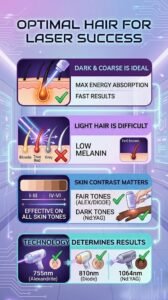
Laser hair removal tends to work particularly well on dark, coarse hair because darker hair generally contains more melanin for the laser to target.
The contrast between hair and skin also matters, although modern laser systems have expanded treatment options for people with darker skin tones. Choosing suitable equipment and an experienced practitioner is important for both results and safety.
Because hair follicles pass through different growth stages, a single laser session cannot effectively target all hairs in an area. Multiple appointments are needed, and some hair may eventually regrow.
Which Is More Permanent: Electrolysis or Laser Hair Removal?
Electrolysis is the more definitive option for permanent hair removal from individual follicles. Laser hair removal is primarily used to achieve lasting hair reduction, although some treated hairs may not return.
The distinction matters because permanent hair removal and permanent hair reduction do not describe exactly the same outcome.
Electrolysis: Permanent Removal of Successfully Treated Hairs
Electrolysis aims to permanently disable the structures that allow an individual follicle to grow hair.
Once a follicle has been successfully destroyed, it should no longer produce hair. However, this does not mean every visible hair can be permanently removed in one appointment or that completing electrolysis guarantees no unwanted hair will ever appear in the area again.
Hairs grow in cycles, and not every follicle can be effectively treated during the same session. Some follicles may also require repeated applications.
Additionally, hormonal changes can stimulate hair growth from follicles that were not previously producing noticeable hair.
For these reasons, electrolysis is generally a gradual process rather than an immediate, one-session solution.
Laser Hair Removal: Long-Term Hair Reduction
Laser hair removal can substantially reduce the number of hairs growing in a treated area.
After a series of treatments, remaining hair may be finer, less noticeable, or slower to regrow. Some follicles may stop producing visible hair for extended periods, while others may eventually recover enough to grow new hair.
The amount of reduction varies with hair colour, skin characteristics, treatment area, laser settings, and individual response.
Some people maintain satisfactory results for a long time without additional treatment. Others choose occasional touch-up appointments.
If your priority is eliminating a small number of specific hairs as permanently as possible, electrolysis may be the better choice. If your goal is reducing dense hair growth across a larger area, laser treatment may be more practical.
Which Treatment Works Better for Different Skin Tones and Hair Colours?
Hair colour is one of the most important differences when choosing between electrolysis and laser hair removal.
Dark Hair
Laser hair removal is generally effective on dark hair because the hair contains melanin that absorbs the laser's energy.
People with dark, coarse hair often have more favourable treatment characteristics than those with very light or fine hair.
Electrolysis also works on dark hair, but the follicle-by-follicle process may be less practical when treating a large area.
For extensive dark hair growth, laser treatment may offer a faster way to achieve substantial reduction.
Blonde, Red, Grey, or White Hair
Electrolysis is usually the more reliable choice for hair that contains little pigment.
Traditional laser hair removal relies on melanin to absorb light energy. Blonde, red, grey, and white hairs may not contain enough suitable pigment for effective treatment.
Electrolysis avoids this limitation because electrical energy is delivered directly into each follicle rather than being absorbed by the hair's colour.
This is particularly relevant for people who want to remove individual grey chin hairs, blonde facial hairs, or other light-coloured hairs.
Darker Skin Tones
Electrolysis can be used across skin tones because it does not depend on a contrast between the hair and surrounding skin.
Laser hair removal can also be an option for people with darker skin. However, selecting the correct laser technology and settings is especially important.
Melanin in the skin can also absorb laser energy, potentially increasing the risk of burns or changes in pigmentation when treatment is not appropriately performed.
Certain laser technologies, including Nd:YAG systems, are commonly used when treating darker skin tones.
A practitioner experienced with the patient's skin type should determine whether laser treatment is appropriate and which settings to use.
Fine Facial Hair
Very fine facial hair can be more challenging to treat with lasers, particularly when it contains little pigment.
Electrolysis may be useful when the goal is to remove individual fine hairs. However, treating widespread fine facial hair can be time-consuming.
Not every type of facial hair needs treatment, and the characteristics of the hair should be assessed before choosing a procedure.
Electrolysis vs. Laser Hair Removal for Different Body Areas
The size of the treatment area can have as much influence on your choice as the type of hair being removed.
| Body area | Treatment considerations |
|---|---|
| Upper lip | Either method may be appropriate, depending on hair colour, density, and desired results |
| Chin | Electrolysis is useful for individual persistent hairs; laser may suit larger areas of dark hair |
| Eyebrows | Electrolysis allows precise treatment; laser treatment near the eyes carries important safety concerns |
| Underarms | Laser treatment is often more practical for widespread dark hair |
| Bikini line | Both methods can be considered; laser treats larger areas faster |
| Legs | Laser generally offers more efficient coverage |
| Back or chest | Laser is usually more practical for extensive hair growth |
| Individual grey or white hairs | Electrolysis is generally preferable |
These are practical distinctions, not universal rules.
Someone with a few coarse chin hairs may find electrolysis more suitable, while another person with extensive dark facial hair may prefer laser reduction.
Similarly, someone seeking permanent removal of a small number of hairs in the bikini area may reasonably choose electrolysis despite the slower process.
The treatment area's sensitivity, the amount of hair, and the practitioner's experience should also influence the decision.
How Many Sessions Do Electrolysis and Laser Hair Removal Need?
Both procedures require repeated visits because hair grows in cycles. However, the length and frequency of the treatment courses can differ considerably.
Laser Hair Removal Sessions
Laser hair removal typically involves a series of appointments spaced several weeks apart.
The exact number depends on the treatment area, hair characteristics, technology used, and how the follicles respond.
A small area such as the upper lip may take only a short time to treat during each visit. Larger areas, including the legs or back, generally require longer appointments.
Although individual sessions can be relatively quick, the complete treatment course usually extends over several months.
Additional maintenance appointments may be recommended if noticeable hair growth returns.
Electrolysis Sessions
Electrolysis appointments can range from brief visits for a few hairs to considerably longer sessions for more extensive treatment.
Since each follicle must be treated individually, the total time required depends heavily on the number and density of hairs.
Appointments may be scheduled regularly over many months, and extensive areas can require a longer course.
Electrolysis does not necessarily require ongoing maintenance of successfully destroyed follicles. However, previously untreated hairs or newly developing hair growth may still need attention.
The key distinction is that laser generally treats more hair in less appointment time, while electrolysis requires greater individual attention to each follicle.
Is Electrolysis More Painful Than Laser Hair Removal?
Electrolysis is often described as more uncomfortable than laser hair removal, although pain varies considerably between individuals.
The sensations are different, and the duration of each treatment can influence how manageable they feel.
What Electrolysis Feels Like
During electrolysis, people may experience repeated stinging, warmth, or prickling as electrical energy is applied to each follicle.
Sensitivity varies by body area. The upper lip and other delicate facial regions may feel more uncomfortable than less sensitive areas.
Because follicles are treated individually, the sensation may be repeated throughout an appointment.
What Laser Hair Removal Feels Like
Laser hair removal is commonly described as a warm snapping sensation, similar to a rubber band against the skin.
Discomfort can vary with the laser technology, treatment settings, hair density, and the area being treated.
Many modern laser devices incorporate cooling technology to protect the skin and improve comfort.
Can Discomfort Be Reduced?
Treatment providers may recommend cooling measures or, in some circumstances, appropriate topical anaesthetics.
Any numbing product should be used according to professional guidance rather than applied independently in large amounts.
Pain tolerance alone should not determine your choice. Treatment effectiveness, safety, and the total time commitment are equally important.
Side Effects and Safety: Which Treatment Has More Risks?
Both electrolysis and laser hair removal can cause temporary skin reactions. More serious complications are less common but possible.
Neither treatment should be considered risk-free.
Laser Hair Removal Side Effects
Common short-term reactions include redness, mild swelling around follicles, tenderness, and temporary irritation.
Less common complications can include burns, blisters, pigmentation changes, or scarring.
The risk depends on factors such as skin tone, recent sun exposure, equipment, treatment settings, and practitioner experience.
Using appropriate laser technology is particularly important for people with darker or recently tanned skin.
Electrolysis Side Effects
Electrolysis may cause temporary redness, swelling, tenderness, or small scabs around treated follicles.
Potential complications include skin irritation, pigmentation changes, infection, and scarring, particularly when technique or infection-control practices are inadequate.
Because the procedure involves inserting a probe into follicles, proper equipment hygiene and practitioner training are essential.
Aftercare for Both Treatments
The skin may be temporarily sensitive following either procedure.
Aftercare instructions commonly involve gentle cleansing, avoiding unnecessary friction or picking at irritated areas, and protecting treated skin from excessive sun exposure.
Depending on the treatment, a practitioner may also advise temporarily avoiding certain skincare products, excessive heat, or activities that aggravate the skin.
Follow the instructions given for your specific procedure rather than assuming the same aftercare timetable applies to everyone.
Seek medical advice if you develop significant blistering, worsening pain, signs of infection, or persistent skin changes.
Choosing an appropriately trained and experienced practitioner is one of the most important ways to reduce avoidable complications.
Electrolysis vs. Laser Hair Removal: Which Costs More?
Laser hair removal may be more cost-effective for treating large areas, while electrolysis can be economical for removing a small number of individual hairs. The total expense depends on more than the price of a single appointment.
What Determines Laser Hair Removal Costs?
Laser treatment prices generally depend on the size of the area, equipment, clinic location, and treatment package.
Although larger areas typically cost more per visit, the laser can target many follicles during one appointment.
This efficiency can make laser treatment practical for extensive hair growth on the legs, chest, or back.
However, the initial treatment series may not be the only expense. Some individuals eventually choose additional sessions to maintain their results.
What Determines Electrolysis Costs?
Electrolysis is frequently priced according to appointment duration.
The cost depends on the practitioner's rates, treatment time, hair density, and number of visits needed.
A small area containing only a few unwanted hairs may require relatively limited treatment time.
By contrast, permanently removing dense hair across a large area can involve many appointments, making the total cost substantial.
Comparing the Total Investment
Rather than comparing one laser session with one electrolysis appointment, consider the full treatment course.
Ask each provider about the estimated number of visits, appointment duration, expected results, and whether additional treatment may be needed.
A precise estimate should be based on your particular treatment area and hair characteristics.
Can You Get Electrolysis After Laser Hair Removal?
People who have undergone laser hair removal may later consider electrolysis, especially when some unwanted hairs remain.
The two methods target follicles differently, but that does not mean they should be performed on the same area without considering the condition of the skin and previous treatment.
If you want to switch methods, have a qualified practitioner assess the area, discuss your treatment history, and determine when another procedure would be appropriate.
Avoid scheduling overlapping treatments without professional guidance, particularly if your skin is still irritated or recovering.
Which Is Better for Hormonal Facial Hair or PCOS?
Hair growth associated with hormonal changes may require additional consideration because removing existing hair does not necessarily address the underlying cause of new growth.
For example, polycystic ovary syndrome (PCOS) can be associated with increased facial or body hair growth.
Laser hair removal may reduce extensive dark, coarse hair, while electrolysis can be useful for treating individual hairs, including hairs that lack sufficient pigment for laser treatment.
However, hormonal influences may stimulate additional hair growth over time, even when previously treated follicles have responded successfully.
Neither electrolysis nor laser hair removal treats the hormonal condition itself.
People experiencing new, rapidly increasing, or otherwise concerning facial or body hair growth should consider medical assessment to identify potential underlying causes.
Electrolysis or Laser Hair Removal: Which Should You Choose?
The better treatment depends on what you want to accomplish and which method is suitable for your hair and skin.
Electrolysis May Be the Better Choice If:
- You want permanent removal of specific hairs.
- Your hair is blonde, red, grey, or white.
- You need precise treatment of a small area.
- You are comfortable with a longer treatment process.
- Laser treatment is unsuitable for your particular hair characteristics.
Laser Hair Removal May Be the Better Choice If:
- You have dark, pigmented hair.
- You want to reduce hair growth over a large area.
- You prefer shorter individual appointments.
- Long-term reduction meets your expectations.
- You are comfortable with the possibility of future maintenance.
For some people, the choice is straightforward. Extensive dark hair growth on the legs may make laser treatment more practical, while several unwanted grey chin hairs may favour electrolysis.
For others, suitability is less obvious, especially when skin pigmentation, hair texture, hormonal changes, or previous treatment experiences complicate the decision.
A consultation with an appropriately qualified professional can help establish realistic expectations, identify risks, and recommend a treatment plan suited to your needs.
Final Verdict: Is Electrolysis Better Than Laser Hair Removal?
Electrolysis is generally the stronger choice when the priority is permanent removal of individual hairs, including light-coloured hairs that lasers struggle to target. Its main disadvantage is the time required to treat follicles one by one.
Laser hair removal is generally more efficient for reducing large areas of unwanted dark hair. Its main limitation is that substantial, lasting reduction does not guarantee every hair will be permanently eliminated.
The best method is therefore not necessarily the one that produces the most permanent result or the fastest appointment. It is the treatment that offers an appropriate balance of effectiveness, safety, time, and cost for your particular situation.