
What Does Dermal Filler Mean?
A dermal filler is a soft, gel-like substance injected beneath the skin to restore lost volume, smooth deep wrinkles, and enhance facial contours like the lips and cheeks.
As we age, our faces naturally lose collagen, fat, and bone. This physical loss creates sagging skin, hollow areas under the eyes, and deep creases around the mouth. These minimally invasive injections act as a structural scaffold under your skin. They offer a safe, fast, and non-surgical way to achieve a youthful, refreshed appearance right inside a doctor’s office. If you are ready to address volume loss with a professional team, you can learn more about our treatments for dermal filler in North York.
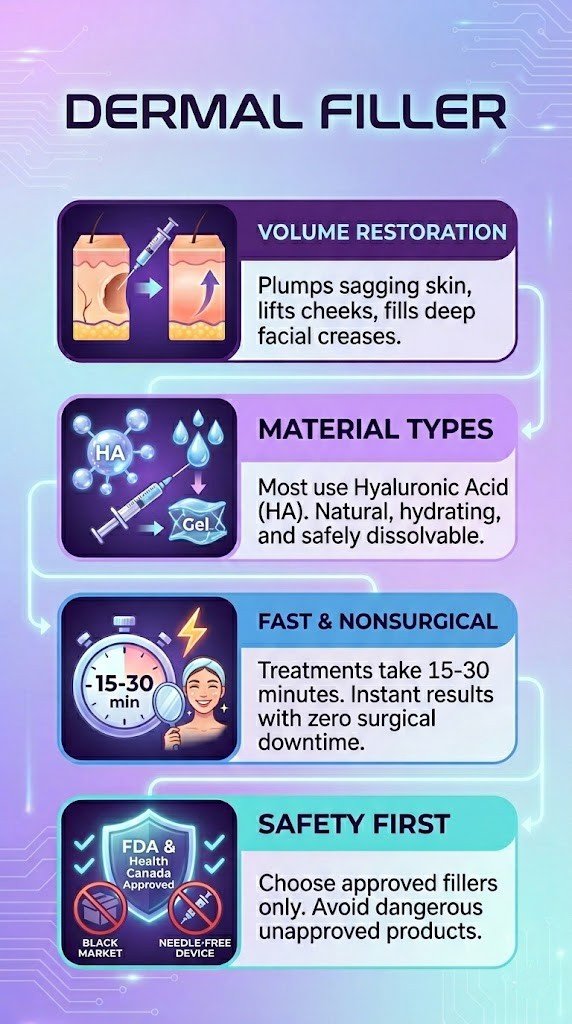
In a Nutshell
Volume Restoration: Fillers physically plump sagging skin, lift flat cheeks, and fill in deep facial creases.
Material Types: Most injections use Hyaluronic Acid (HA), a natural, hydrating substance that a doctor can safely dissolve if needed.
Fast & Nonsurgical: Treatments take 15 to 30 minutes with instant results and require zero surgical downtime.
Safety First: Always choose FDA and Health Canada-approved fillers. You must completely avoid dangerous “black market” products or needle-free injection devices.
How Do Dermal Fillers Actually Work?
To understand how these injections work, you first need to understand how the human face ages. The overall structure of your face relies on four main components: skin, fat, muscle, and bone.
Over time, you naturally lose bone mass. This causes the jawline to pull back and the high cheekbones to flatten. Your facial muscles also shrink and lose elasticity. Furthermore, the fat pads that keep your face looking plump begin to deflate and slide downward due to gravity. Finally, your skin stretches out and loses its firm scaffolding.
When you combine bone loss, shrinking muscles, sliding fat, and stretching skin, you get visible signs of aging. You will notice wrinkles, hollow areas, and sagging. Dermal fillers work by physically replacing this lost structural support. A medical provider injects the gel directly beneath the surface of the skin to act as a replacement scaffold. This action instantly plumps up flat cheeks, smooths out deep folds around the mouth, and lifts sagging areas back into their proper place.
What Are the Different Types of Dermal Fillers?
Not all fillers are exactly the same. Medical professionals use several different FDA-approved substances depending on the area of the face they are treating.
Hyaluronic Acid (HA)
Hyaluronic acid is a naturally occurring sugar found in your body that keeps your skin hydrated and plump. It can hold up to 1,000 times its own weight in water. HA fillers are soft, look very natural, and typically last six to twelve months. The biggest advantage is that they are completely reversible. If you do not like the result, a doctor can inject an enzyme to dissolve the gel immediately. Because of its soft texture, HA is the top choice for lip fillers in North York.
Calcium Hydroxylapatite (CaHA)
Calcium hydroxylapatite is a mineral-like compound naturally found in human bones. Brands like Radiesse use this substance. It is thicker than hyaluronic acid and lasts longer, usually around a year or more. Doctors use CaHA to treat deeper wrinkles, enhance the jawline, and restore lost volume in the cheeks. It is also uniquely approved by Health Canada to treat volume loss in the back of the hands.
Poly-L-lactic Acid (PLLA)
Poly-L-lactic acid is a biodegradable, synthetic material. Unlike standard gels that just fill space, PLLA acts as a collagen stimulator. Brands like Sculptra use this material to force your body to naturally produce its own collagen. The results are not instant. Instead, the volumization happens gradually over several months as your skin rebuilds itself. The results can last two years or longer.
Polymethylmethacrylate (PMMA)
Polymethylmethacrylate is considered a semi-permanent filler. Brands like Bellafill use PMMA. This product contains microscopic, smooth plastic beads suspended in a solution of bovine (cow) collagen. After injection, the collagen provides instant volume, and the tiny plastic beads remain under the skin permanently to keep the tissue firm.
Autologous Fat Grafting
This is a surgical option that uses your own body fat instead of an off-the-shelf product. A doctor performs liposuction to remove fat from an area like your stomach or thighs. They purify the fat and then inject it into your face to restore volume. Because it involves liposuction, the recovery time is longer than standard gel injections.
What Happens During a Filler Appointment?
Getting a dermal filler is a fast, outpatient procedure. It usually takes between 15 and 30 minutes.
First, you will have a consultation where the provider maps out your face and discusses your goals. Next, they will clean your skin and apply a topical anesthetic cream to numb the area. Many modern fillers also have lidocaine (a numbing agent) mixed directly into the syringe to make the process comfortable.
Using a very fine needle or a blunt-tipped flexible tube called a cannula, the provider carefully injects small amounts of the gel under your skin. You might feel a slight pinch or pressure, but it is rarely painful. Afterward, they will cleanse your face again and provide an ice pack to help with any swelling.
For your aftercare, you must follow the 48-hour rule. You need to avoid direct sun exposure, saunas, and intense sports or heavy lifting for two full days. This prevents excessive swelling and keeps the product perfectly in place while it settles.
Are Dermal Fillers Safe?
When performed by a licensed medical professional, dermal fillers are very safe. However, like any medical procedure, they carry certain risks.
Normal, temporary side effects include mild bruising, swelling, redness, itching, and tenderness at the injection site. These usually disappear within a few days.
There are also severe, though very rare, risks. The most dangerous complication is vascular occlusion. This happens if an untrained injector accidentally pushes the filler gel directly into a blood vessel. This blocks the blood flow, which can cause skin necrosis (the death of the tissue) or even permanent blindness if injected near the eyes.
Important FDA Warnings: The FDA has issued strict warnings about dangerous practices. You should never buy cheap, black-market fillers online. They are often fake, contaminated with harmful chemicals like hair gel, and can cause massive infections. The FDA also explicitly warns against using liquid silicone for body contouring, as it causes permanent disfigurement. Finally, never use “needle-free” high-pressure injection pens. These devices force hyaluronic acid into the skin using extreme pressure, which causes serious, permanent harm to the skin and eyes.
Who Should Avoid Getting Fillers?
While fillers work well for most people, certain groups should avoid them. You are not a good candidate if you are pregnant or breastfeeding. You must also avoid the treatment if you have an active skin infection, severe eczema, or a psoriasis breakout in the exact area you want treated. People with bleeding disorders or severe allergies to the ingredients (like bovine collagen) should also avoid these injections.
How Much Do Dermal Fillers Cost?
The cost of this cosmetic procedure varies based on your location and the provider’s experience. On average, you can expect to pay between $500 and $1,500 per syringe. The final price depends entirely on the type of material used and how many areas of the face you are treating. Because the body eventually absorbs most fillers, you will need to pay for maintenance treatments every year to keep your results.
Frequently Asked Questions
How long does dermal filler last?
The longevity depends on the specific material used and your body’s natural metabolism. Temporary hyaluronic acid fillers typically last between 6 and 12 months. Thicker products like calcium hydroxylapatite last around a year, while collagen stimulators like Poly-L-lactic acid can last up to two years or more.
What is the difference between dermal fillers and regular fillers?
Many people confuse dermal fillers with Botox, but they do completely different things. Botox is a drug that relaxes specific facial muscles to stop wrinkles from forming when you make expressions. Dermal fillers do not relax muscles. They physically add gel beneath the skin to fill in hollow spaces, plump lips, and push up deep static folds.
What does a dermal filler do?
A dermal filler adds physical volume under the skin. It plumps thin lips, lifts flat and sagging cheeks, and smooths out deep nasolabial folds (the smile lines between your nose and mouth). Doctors also use it to improve the appearance of recessed acne scars and restore facial fat loss in patients with certain medical conditions.
What is the downside of dermal fillers?
The main downside is that most fillers are temporary. You will need to return for regular appointments to maintain your look, which adds an ongoing financial cost. Additionally, they carry rare but very serious medical risks, such as tissue death or vision loss, if the procedure is performed poorly by an unqualified, unlicensed injector.
Final Words
Moonlight Beauty
- Address: 5 Fairview Mall Dr, Unit 490, North York, ON M2J 2Z1
- Phone: (647) 548-7949